
Pipe relining cost in Sydney: what you pay per metre, and why
Pipe relining in Sydney costs between $400 and $1,200 per metre. Most whole residential jobs land between $3,000 and $15,000.
The spread is that wide because pipe diameter, depth and the number of junctions matter far more than length does. A single patch on a 100mm line is a completely different job from relining a full run under a terrace with four branch connections.
Those are the published Sydney market ranges. What Angelo quotes on your job comes after a camera inspection, and the rest of this page explains why no honest drainer can give you a real number before then.
Why nobody can quote relining over the phone
A relining quote has four variables and none of them are visible from the street.
- How much pipe is actually damaged. A root intrusion at one junction is a patch. A collapsed earthenware line running the length of a terrace is a full reline. Until a camera has been down there, the difference is a guess.
- Pipe diameter. A 100mm sewer line and a 150mm line use different liners and different volumes of resin.
- Depth and access. If there is an existing inspection opening, the crew works through it. If there is not, one has to be cut, and that is excavation.
- Junctions. Every branch line that joins the main has to be reinstated after the liner cures, and each one is a separate operation.
Two quotes on the same house can differ by thousands simply because one has allowed for junction reinstatement and the other has not.
Pipe relining cost in Sydney, broken down
| What | Typical Sydney range |
|---|---|
| CCTV camera inspection | $300 to $440 |
| Patch reline, single section | $1,500 to $3,000 |
| Full reline, 100mm pipe | $400 to $700 per metre |
| Full reline, 150mm and above | $500 to $1,200 per metre |
| Junction reinstatement | $690 to $800 each |
| New access point, requires excavation | from $4,400 |
| Typical whole residential job | $3,000 to $15,000 |
These are the ranges Sydney plumbers publish openly. Angelo quotes your specific job after seeing the pipe, and the quote is fixed before any work starts.
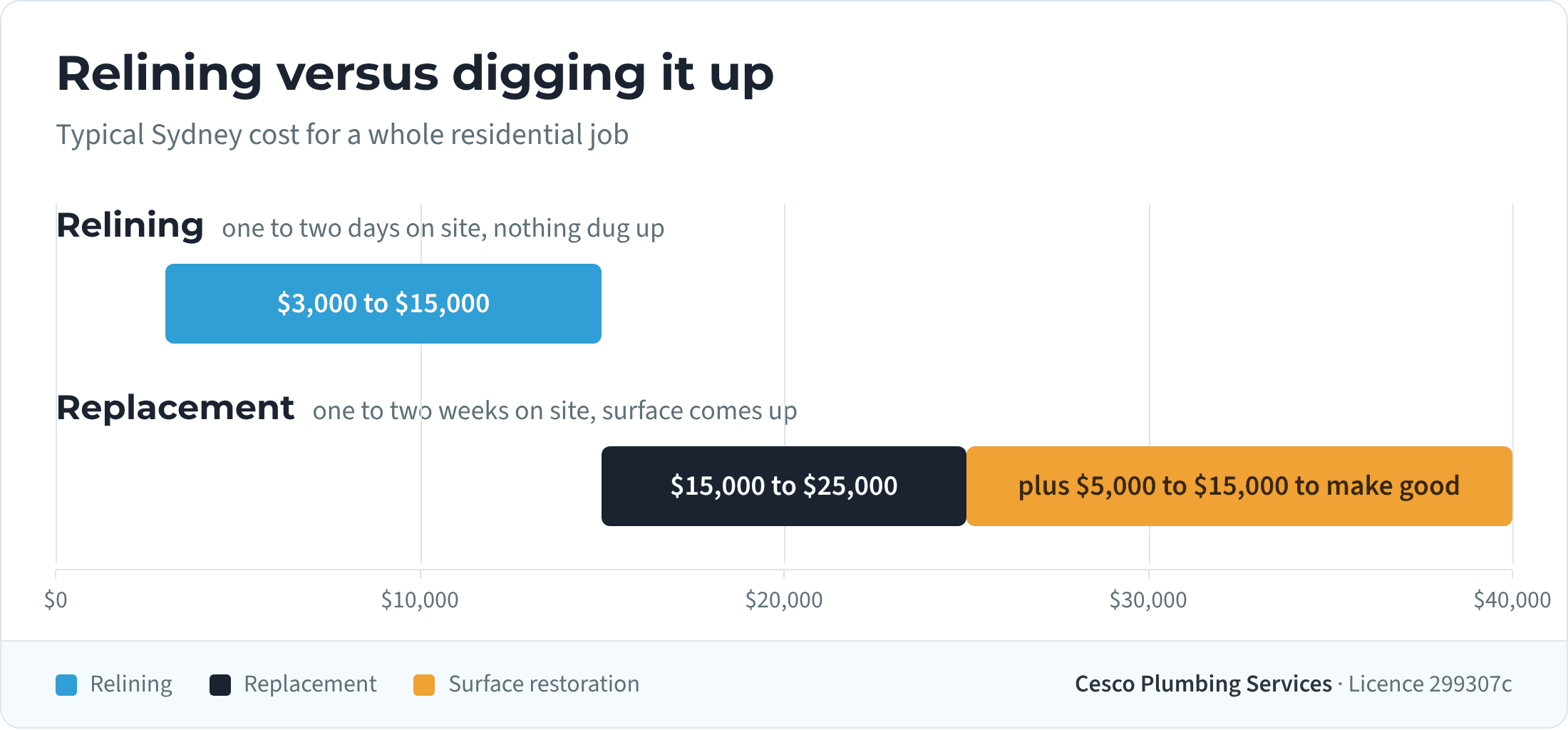
Relining versus digging it up
Replacement means excavation. On an Inner West terrace that usually means lifting a paved courtyard, cutting through a driveway, or taking out a garden that took ten years to establish.
| Relining | Replacement | |
|---|---|---|
| Typical cost | $3,000 to $15,000 | $15,000 to $25,000 |
| Surface restoration | None | $5,000 to $15,000 |
| Time on site | One to two days | One to two weeks |
| Disruption | Minimal | Significant |
| Design life | 50 years | 50 to 100 years |
Relining is not always the right answer. If the pipe has collapsed completely, there is nothing left to line and it has to come out. A camera inspection tells you which situation you are in before anyone commits.
What makes an Inner West job different
Older Sydney suburbs have older pipes. Haberfield, Leichhardt, Balmain, Annandale and Rozelle are full of original earthenware and terracotta sewer lines, many laid before 1940.
Earthenware fails in a predictable way. The joints open slightly as the ground moves, fine roots find the gap, and over a few seasons the roots thicken and block the line. The pipe is not broken so much as slowly invaded.
That is close to the ideal case for relining. The host pipe is still structurally there, so the liner has something to cure against, and the finished line is seamless with no joints for roots to find again.
Terraces with shared boundary drainage are the complication. If the damaged section sits in a line shared between two properties, the cost conversation involves your neighbour, and that is worth knowing before the quote arrives rather than after.
How the job runs
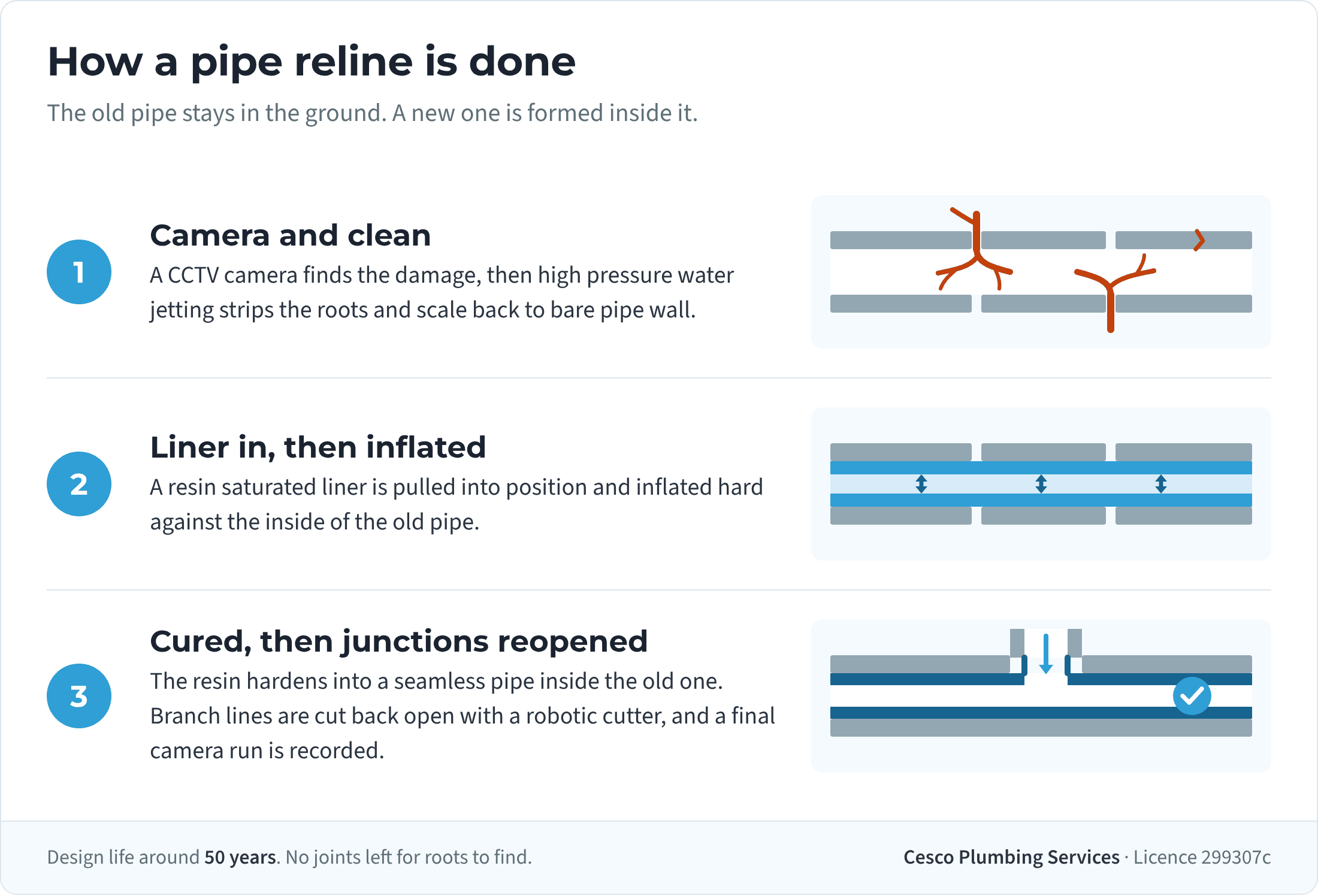
- Camera inspection. A CCTV drain camera goes down the line and the footage is recorded. You see it too.
- Clean and prepare. High pressure water jetting clears roots, scale and debris so the liner bonds to clean pipe wall.
- Measure and cut the liner. Cut to the length of the damaged section, not the whole line, unless the whole line needs it.
- Install and inflate. The resin saturated liner is pulled into position and inflated against the pipe wall.
- Cure. The resin hardens into a new pipe inside the old one, typically in a few hours.
- Reinstate junctions. Any branch lines closed off by the liner are cut back open with a robotic cutter.
- Final camera run. Recorded, and you get a copy.
The finished internal diameter is a few millimetres smaller than the original. On a sewer line that makes no practical difference to flow.
When relining is the wrong call
Be wary of anyone who recommends relining before they have put a camera down the pipe. It is not always the answer.
- Fully collapsed pipe. No host pipe, nothing to line against.
- Severe misalignment. If sections have dropped out of line, a liner locks the fault in permanently.
- Very short runs near the surface. Sometimes digging up two metres of shallow pipe is cheaper and faster.
- Pipe too far gone over too long a run. At some point the economics tip toward replacement.
An honest drainer will tell you when digging is the better option.
Common questions
How long does pipe relining last?
A properly installed liner has a design life of around 50 years. Most manufacturers warrant the liner material for that period.
Does relining reduce water flow?
It reduces the internal diameter by a few millimetres. On a 100mm sewer line the effect on flow is negligible, and the smooth seamless surface often improves flow compared with a rough old earthenware pipe.
How long does the job take?
Most residential jobs are done in one to two days, including the camera inspection, the clean and the cure. Larger or multi junction jobs take longer.
Do I need council approval for pipe relining?
Not for relining an existing private sewer or stormwater line on your own property. If the work extends into Sydney Water infrastructure, different rules apply and Angelo will tell you before anything starts.
Can tree roots get back in after relining?
Not through the lined section. The liner is seamless, so there are no joints for roots to exploit. Roots can still enter an unlined section further along the line, which is why the camera run matters.
Is pipe relining covered by home insurance?
Sometimes, if the damage was sudden rather than gradual. Most policies exclude gradual deterioration and root intrusion. Check your product disclosure statement, and keep the camera footage either way.
Contact us
Want to speak to Angelo?
He answers his own phone, day or night. No call centre, no message bank, no waiting until Monday. If it can hold until the morning, send the form instead and he will ring you back.
0434 410 612- Hours 24 hours, 7 days, public holidays included
- Email [email protected]
- Areas All of Sydney, based Inner West
Send an enquiry
For anything urgent, call. The form is for jobs that can wait until the morning.